李晨悦的生活照片

Research & Engineering

李晨悦

Research Engineer / AI Engineer

LLM · Multimodal · Agent · Evaluation

I am an undergraduate at Jiangnan University, expected to graduate in 2028. My projects span agent execution and failure attribution, recommender evaluation, and multimodal data selection and fine-tuning, with a focus on reliable AI systems and reproducible experiments.

01

Academic Research

All academic research

Independent research, engineering explorations, and disclosure-safe updates, organized around questions, methods, and evidence.

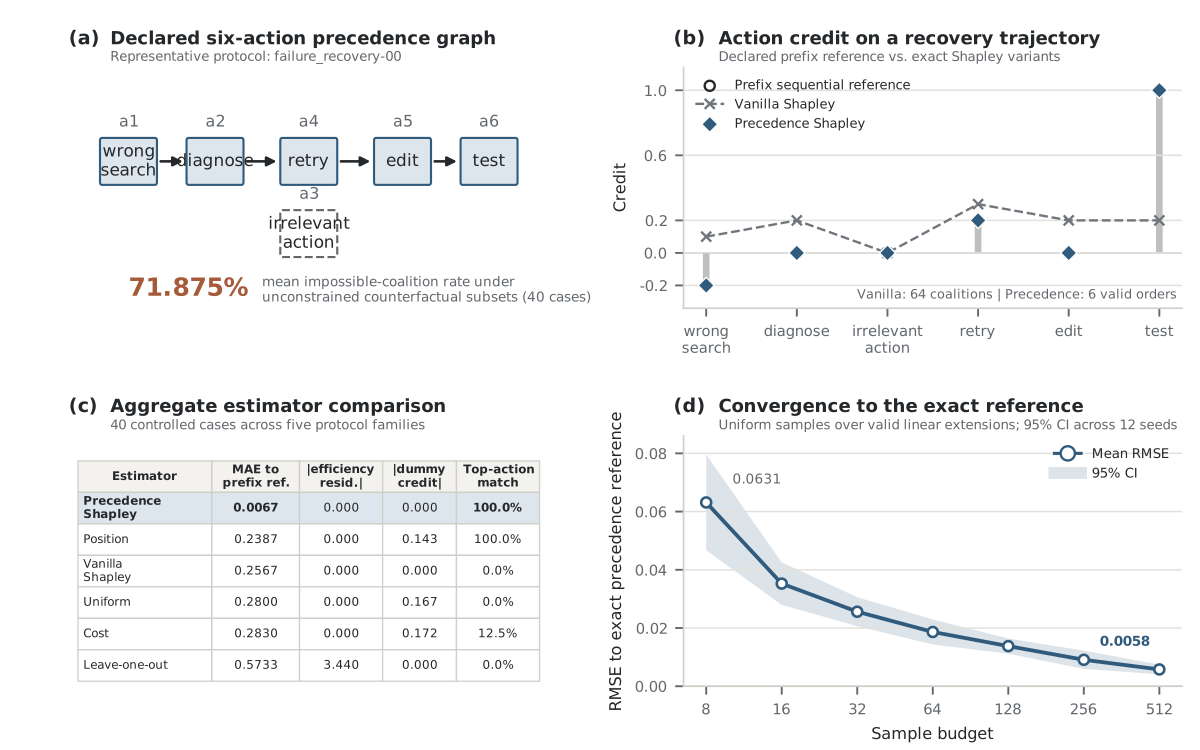
Publication figure for ordered trajectory attribution: a six-action recovery DAG, action-level credit comparison, six-estimator aggregate table over forty cases, and Monte Carlo convergence across twelve seeds.
Swipe horizontally to inspect the full figure

MiniClaudeCode: Ordered Trajectory Credit & Agent Evaluation

01 / Independent project Offline estimator study
Research question
How should actions receive credit when tool trajectories contain prerequisites, interactions, and failure recovery?
Method
Constrain counterfactual replay with a precedence DAG, combining exact enumeration, uniform sampling of valid orders, and offline evaluation.
Key results
  • Under the controlled protocol, precedence-constrained estimates are closer to the prefix reference than vanilla Shapley.
  • Exact estimation, sampling convergence, and replay-validity analyses are publicly documented.
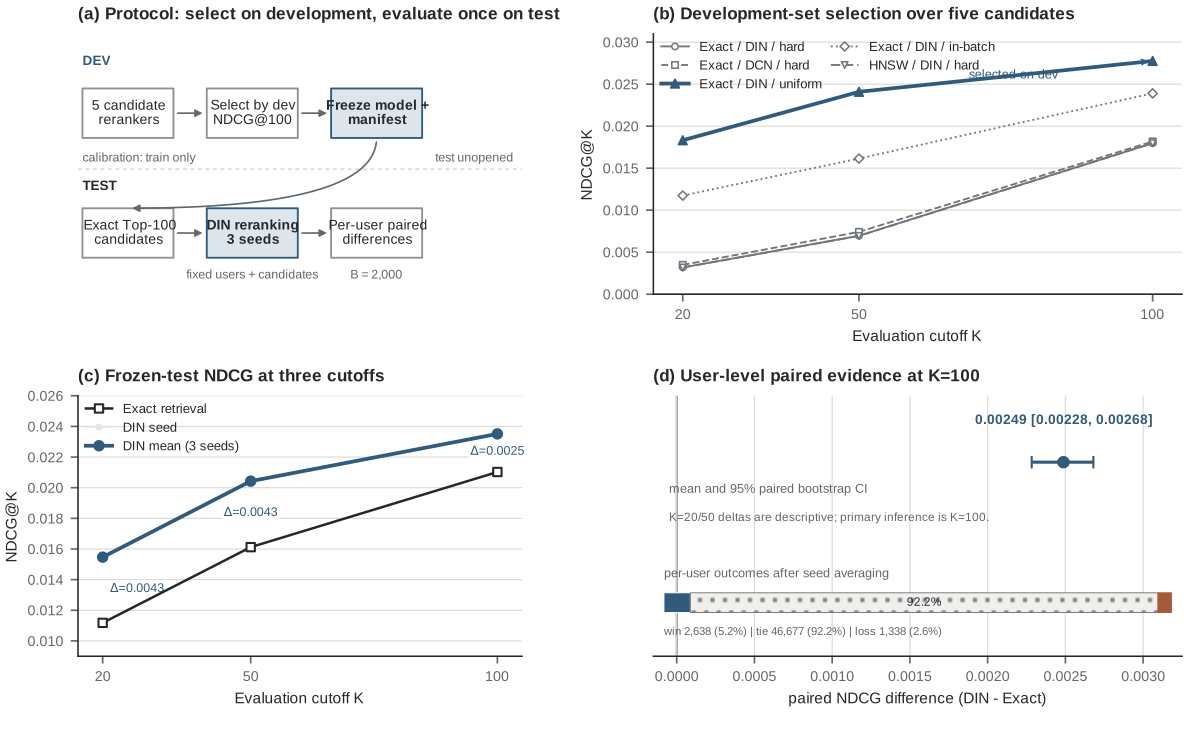
Publication figure for offline recommendation: selection among five development candidates, Exact-versus-DIN results at three frozen-test cutoffs, and user-level paired differences, interval, wins, ties, and losses.
Swipe horizontally to inspect the full figure

KAI Offline RecSys Lab: Retrieval-to-Reranking Evaluation

02 / Independent project Public data · offline experiments
Research question
How can retrieval, negative sampling, and reranking be compared under the same population, data splits, and candidate sets?
Method
Freeze Two-Tower retrieval and Exact / HNSW candidates, compare DIN / DCN rerankers, and apply train-only calibration with paired user-level evaluation.
Key results
  • DIN reranking improves ordering within the same candidate sets under the frozen offline protocol.
  • Uniform negatives win this dev comparison; feature dependencies and ANN trade-offs remain visible.
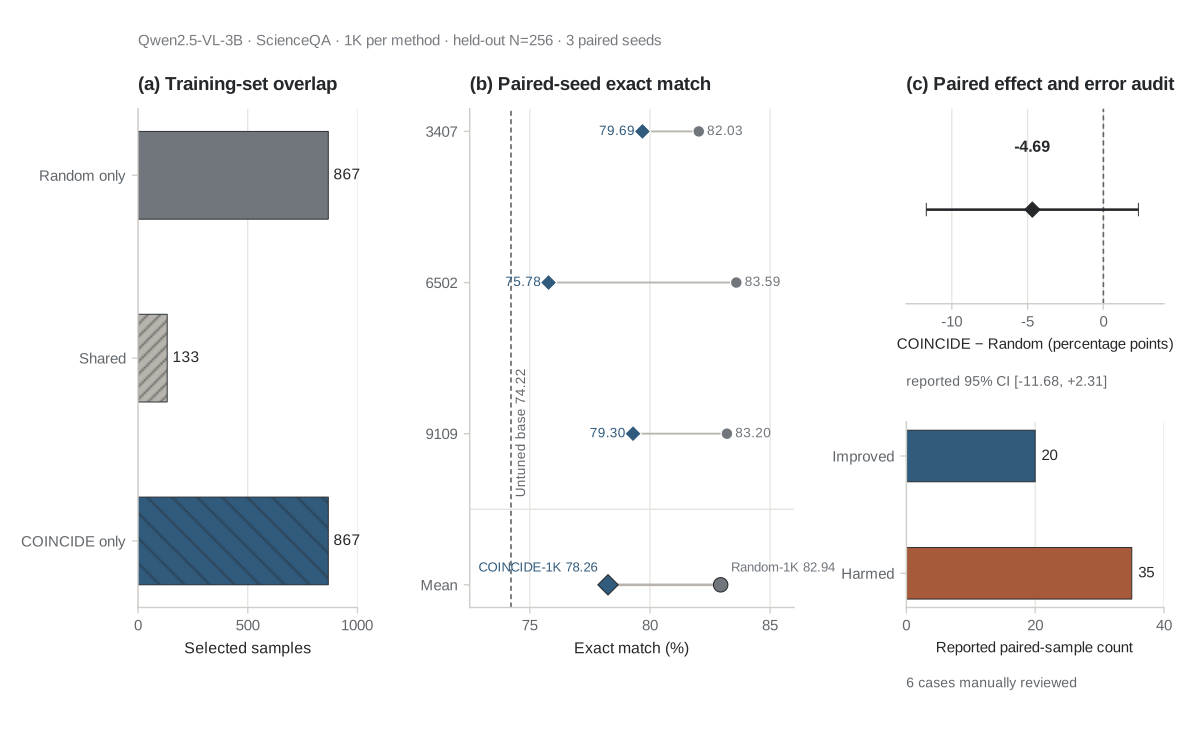
Publication figure for multimodal data selection: Random and COINCIDE subset overlap, exact match for three paired seeds and the untuned base, plus the paired interval and improved-versus-harmed audit counts.
Swipe horizontally to inspect the full figure

Qwen2.5-VL: Data Selection Under a Small Fine-Tuning Budget

03 / Independent project Offline experiment · public summary
Research question
With the model, training budget, and held-out evaluation fixed, can data selection improve multimodal fine-tuning over random sampling?
Method
Compare Random-1K and faithful COINCIDE-1K on ScienceQA with the same Qwen2.5-VL-3B, LoRA / SFT settings, and paired seeds.
Key results
  • In the public summary, COINCIDE-1K trails Random-1K across all three paired seeds.
  • Negative results, a confidence interval crossing zero, and selection-mismatch analysis are retained.
02

Research & Industry

Experience

Tencent Music

Java Backend & AIGC Application Engineering Intern

Dates to be added

Schneider Electric

Intern

03

Open Source

All contributions

Contributions, maintained repositories, and infrastructure for reproducible research.

Pull requestSubmitted · not merged (2026-09-09)

PyRIT: Garak API-key Scenario & Scorer

microsoft/PyRIT

External contribution PR #2538 adds API-key generation and completion probes to the Garak scenario family.

Contribution
Submitted the scenario, fixed corpora, CredentialLeakScorer extensions, tests, and documentation. The implementation distinguishes credential-shaped values from public identifiers and excludes request echoes and supplied test fragments.
Result
The code diff and test notes are public. The contribution is submitted but unmerged; submission alone does not establish maintainer endorsement or validation against live targets.
RepositoryPersonal repository · source available

MiniClaudeCode: Observable Execution & Evaluation Infrastructure

hey-Chloe/MiniClaudeCode

A personally maintained coding-agent reference implementation focused on execution boundaries, tool events, checkpoints, and evaluation.

Contribution
Published a bounded control loop, tool registration and policy interfaces, session persistence, trajectory attribution, and evaluation scripts. Third-party training frameworks carry separate attribution.
Result
Source, controlled reports, and test entry points are available. Offline harness validation is distinct from real-model task solving; the repository currently grants no additional open-source license.
InfrastructurePersonal repository · research infrastructure

KAI RecSys Lab: Experiment Protocols & Reporting Tools

hey-Chloe/KAI-Offline-RecSys-Lab

Provenance ledgers, frozen configurations, evaluation reports, and portable experiment views built around public data.

Contribution
Connect retrieval, reranking, calibration, and paired statistics under one offline protocol, with synthetic-path reproduction, public-report checks, and a static Playground.
Result
Reports distinguish public-data experiments, synthetic integration checks, ANN systems measurements, and local serving rehearsals, without presenting offline findings as online business gains.
04

Engineering

All projects
2026Agent UI / Vue / FastAPI / SSE

MiniClaudeCode Studio

A Chinese-language agent workspace that brings plans, tool calls, approvals, code diffs, tests, and checkpoint recovery into one traceable workflow.

Problem
Make agent execution, file changes, and verification outcomes observable and distinct.
Ownership
The personal repository's Studio adapter and interface reuse MiniClaudeCode's native execution engine. The public version replays recordings; the local version connects to the actual runtime.
Outcome
A local workspace, static replays, and a small online evaluation distinguish execution ending, functional correctness, and final verification, while retaining failures caused by permissions and interpreter selection.
2026Static analysis / Semgrep / FastAPI / Vue

RuleForge-SAST

A static-analysis workflow for PHP, Python, and Java: rule scanning, vulnerability explanations, AI repair suggestions, rescanning, and history.

Problem
Separate an AI repair suggestion from scanner findings, with inspectable evidence before and after a change.
Ownership
The personal repository connects language and rule selection, scan records, AI suggestions, and Patch Verify across the frontend and backend. Detection uses Semgrep and existing rules.
Outcome
Scanning, AI suggestions, and repair checks form a traceable workflow with a demo and scan history. FIXED means the current rule no longer matches; coverage depends on the rules used.

05

Research Notes

All writing

研究进行中|AI Coding Benchmark 可复现性审计

检查公开数据、任务资产与评测程序在不同发布视图之间是否保持一致,并建立可追溯的离线验证流程。

Research Update · AI Coding · Agent Evaluation · Reproducibility · 2 min read